

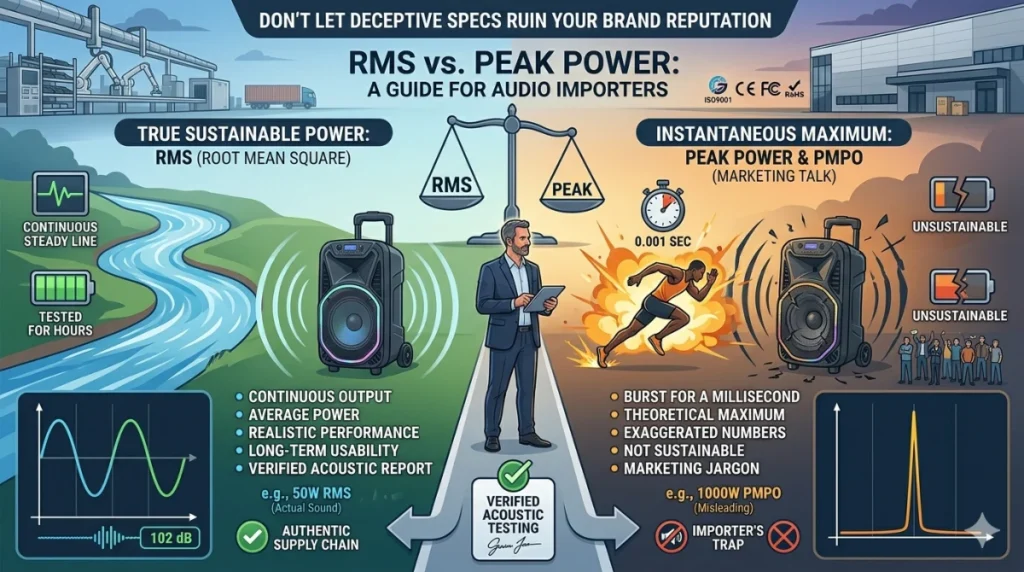
When sourcing outdoor trolley speakers or portable PA systems from overseas, the first specification buyers look at is usually the power output. It’s natural to want the loudest, most powerful speaker for your budget. However, navigating the audio spec sheets provided by various suppliers can often feel like walking through a minefield of marketing jargon.
The biggest point of confusion—and the most common tactic used to mislead buyers—is the difference between Peak Power (or PMPO) and RMS Power.
For audio importers, wholesalers, and brand owners, understanding this difference is critical. It determines not only the true performance of the product you are importing but also the reliability of the manufacturer you are partnering with.
The Illusion of Peak Power and PMPO
Let’s start with the big, flashy numbers you often see on packaging: 1000W, 2000W, or even 5000W. These are almost always referring to Peak Power or PMPO (Peak Music Power Output).
- Peak Power: This refers to the absolute maximum amount of power a speaker can handle for a tiny fraction of a second (usually during a sudden, loud sound like a drum crash) without blowing the voice coil. It is not sustainable.
- PMPO: This is essentially a marketing term with no standardized mathematical definition. It represents a theoretical, instantaneous maximum that the speaker might survive under perfect laboratory conditions for a millisecond.
Why it’s a trap for buyers: Unscrupulous suppliers use Peak Power or PMPO to make a cheap, weak speaker look incredibly powerful on paper. A speaker marketed as “1000W PMPO” might sound terrible when played at half volume and will likely fail if pushed hard during a party.
The Reality of RMS Power
If you want to know how loud and clear a speaker will actually sound in the real world, you must look at the RMS (Root Mean Square) power rating.
- What is RMS? RMS is a mathematical formula that calculates the continuous, average power output a speaker can comfortably and safely handle over a sustained period.
- Why it matters: RMS is the true measure of a speaker’s strength. A speaker with a genuine 50W RMS rating will consistently produce clean, robust sound during a 3-hour outdoor event. It will almost certainly sound louder and significantly clearer than a cheaply made speaker claiming “1000W PMPO.”
When comparing products from different factories, you must ensure you are comparing RMS to RMS.
How to Spot Honest Audio Manufacturers
The way a factory presents its power ratings is a massive indicator of their overall business ethics and technical capability.
Here is how you can use power ratings to evaluate potential suppliers:
- Ask for the Amplifier Specs: Don’t just ask about the speaker driver; ask about the amplifier board inside. If a supplier claims a speaker is 100W RMS, but the amplifier IC (Integrated Circuit) they use is only rated for 30W, they are lying. A verified manufacturer will happily share details about their DSP chips and amplifier configurations.
- Request Acoustic Testing Reports: Serious audio factories have dedicated acoustic testing rooms. Ask to see the frequency response charts and THD (Total Harmonic Distortion) reports at the claimed RMS power.
- Beware of the “More is Always Better” Pitch: If a salesperson only talks about massive Peak numbers and dodges questions about RMS, continuous testing, or battery drain under high load, walk away.
The Balance Between Power and Portability
For trolley speakers, high RMS power requires high-capacity batteries to sustain it. A true 100W RMS speaker pulling current will drain a small battery in minutes. Therefore, an honest manufacturer will also provide realistic playtime estimates based on playing the speaker at 70% or 80% volume, not just standby time.
Partnering with Transparency
At NDR, we believe that long-term B2B partnerships are built on technical honesty and verifiable quality. As a professional manufacturer of portable PA systems and outdoor trolley speakers, we refuse to play the PMPO numbers game.
When you review our product catalog, the power ratings you see are genuine RMS figures, backed by strict in-house acoustic testing and component verification. Whether you are looking for a reliable 40W RMS portable unit or a massive 150W RMS dual-woofer system, we deliver the exact performance we promise.
Don’t let deceptive specs ruin your brand reputation. Contact our engineering and sales team today to discuss the true acoustic requirements for your next audio project.